
An 8-month emergency fund is a savings target equal to eight months of essential expenses, designed to protect against prolonged job loss or financial shocks in today's economy. Unlike the outdated 3-6 month advice from decades ago, eight months gives you genuine career flexibility and peace of mind when industries shift overnight.
An 8-month emergency fund is a savings target equal to eight months of essential expenses, designed to protect against prolonged job loss or financial shocks in today's volatile economy. Unlike the outdated 3-6 month advice from decades ago, eight months gives you genuine career flexibility and peace of mind when industries shift overnight.
In 2025's economy, 8 months isn't just safer—it's strategic. While others scramble for survival during job transitions, you'll have the luxury of choice. Average job searches now stretch 4-6 months for professional roles, and that's before accounting for industry-specific downturns, AI-driven disruption, or the global competition that remote work has unleashed. Here's why 8 months has become the new gold standard for financial freedom—and how to calculate your exact target today.
If you want to see how your current savings translate to actual months of runway, check out our financial runway calculator first—it gives you a concrete baseline before deciding your target.
What's Your Emergency Fund Runway?
Calculate how many months of freedom you can afford right now
Example: $30,000 saved ÷ $3,000/month = 10 months of freedom
The 3-6 Month Rule is Broken
Traditional emergency fund advice comes from a different era. When financial experts first recommended 3-6 months of expenses, the average job search took 2-3 months and career pivots were rare.
Today's reality is different:
- Average job search: 4-6 months for professional roles
- Industry volatility: Tech layoffs, economic uncertainty, AI disruption
- Remote work competition: You're competing globally, not locally
- Career pivots: Most people change careers 5-7 times in their lifetime
The old advice leaves you vulnerable. Six months feels like safety, but it's actually desperation with a timeline. Our 6-month emergency fund guide explains why even that benchmark falls short for most households today.
For a deeper comparison of different savings targets and how they stack up against real-world scenarios, see our guide on how much you really need in an emergency fund. It breaks down the math for 3, 6, 8, and 12-month funds so you can choose the right target for your specific career and family situation.
For most professionals, the journey starts with understanding how much you really need in an emergency fund before deciding on the right target for your situation.
The 8-Month Advantage: From Survival to Strategy
Eight months transforms your relationship with work. Instead of accepting the first offer out of desperation, you can:
Be Selective About Opportunities
- Turn down roles that don't align with your values
- Negotiate better compensation packages
- Wait for positions that advance your career, not just pay bills
Invest in Skills During Transitions
- Take courses to upskill during job searches
- Build side projects that could become businesses
- Network strategically instead of frantically
Make Strategic Career Moves
- Leave toxic workplaces without a backup plan
- Start businesses or go freelance without panic
- Take sabbaticals for mental health or family
Eight months isn't just an emergency fund—it's a career freedom fund. Once you reach this milestone, you're well on your way to the mindset shift described in transforming your emergency fund into a freedom fund.
If you're curious how far your current savings already stretch, try our financial runway calculator. It shows exactly how many months you could survive without income, which helps you set a realistic timeline for reaching the full 8-month target.
Calculate Your 8-Month Freedom Fund
Use this calculator to determine exactly how much you need for true financial flexibility:
Download our spreadsheet to calculate your freedom number now
Monthly Essential Expenses
- Housing: Rent/mortgage, utilities, insurance
- Food: Groceries and basic dining (not entertainment)
- Transportation: Car payments, fuel, public transit
- Insurance: Health, life, disability (non-employer)
- Debt Minimums: Credit cards, loans (minimum payments only)
- Basic Services: Phone, internet, essential subscriptions
Sample Calculation
Let's say your monthly essentials total $4,200:
- 3 months: $12,600 (desperation territory)
- 6 months: $25,200 (false security)
- 8 months: $33,600 (true freedom)
That extra $8,400 beyond the 6-month mark? It's the difference between taking any job and taking the right job.
The Hidden Costs of Inadequate Emergency Funds
Career Damage: Accepting subpar roles to pay bills can set your career back years. A $10,000 salary reduction taken in desperation costs $100,000+ over a decade.
Health Impact: Financial stress during job loss compounds the already difficult transition. Medical bills from stress-related issues can drain your fund faster.
Relationship Strain: Money arguments peak during unemployment. Having adequate reserves prevents financial stress from destroying relationships.
Opportunity Cost: Without adequate runway, you can't invest in opportunities. That business idea, freelance project, or consulting gig remains unexplored.
Real-World 8-Month Success Stories
Sarah, Software Developer: Laid off in tech downturn. Used 8 months to learn AI/ML, landed role with 40% salary increase.
Mike, Marketing Manager: Quit toxic job without backup. Spent 6 months building freelance practice, now earns 60% more working 30 hours/week.
Jessica, Teacher: Used sabbatical year to transition into instructional design. 8-month fund allowed patient job search, found remote role with 50% pay bump.
The pattern is clear: adequate runway enables strategic decisions that compound financially over decades. A solid savings rate is what fuels this runway over time. Even a modest increase in how much you save each month can shave years off the journey to full financial independence.
If you're just starting out, our progressive emergency fund strategy offers a step-by-step path from zero savings to full 8-month coverage without overwhelming your budget. It breaks the goal into four manageable phases so you can build momentum without sacrificing your quality of life.
How to Build Your 8-Month Fund (Without Living Like a Monk)
Phase 1: Foundation (Months 1-2)
Target: $2,000-3,000 Strategy: Cut obvious waste, automate savings
- Cancel unused subscriptions
- Cook more meals at home
- Save all windfalls (tax refunds, bonuses)
Phase 2: Acceleration (Months 3-8)
Target: One month of expenses saved Strategy: Increase income, optimize spending
- Side gigs or freelance work
- Sell items you don't need
- Negotiate bills (insurance, phone, internet)
Phase 3: Momentum (Months 9-18)
Target: 3-4 months of expenses Strategy: Systematic approach
- Automate 20% of income to emergency fund
- Track progress weekly to maintain motivation
- Consider high-yield savings for growth
Phase 4: Freedom (Months 19-24)
Target: 8 months of expenses Strategy: Optimize and protect
- Max out high-yield savings accounts
- Keep 2 months in checking, 6 months in savings
- Never touch this money except for true emergencies
Wondering how much interest your fully-funded emergency account could generate? Use our savings interest calculator to see how compound growth adds up—even in a conservative high-yield account.
Where to Keep Your 8-Month Fund
Liquidity is king. Your emergency fund needs to be accessible within 24-48 hours without penalties.
Recommended Structure:
- 2 months: High-yield checking account (immediate access)
- 4 months: High-yield savings account (1-day transfer)
- 2 months: Money market or short-term CDs (2-7 day access)
Current Top Rates (2025):
- Marcus by Goldman Sachs: 4.25% APY
- Ally Bank Online Savings: 4.20% APY
- Capital One 360: 4.15% APY
Even at 4% APY, your 8-month fund generates $1,300+ annually in interest—meaningful returns while maintaining liquidity. That passive income alone can cover a month of groceries or a utility bill, effectively extending your runway without any extra effort on your part.
Beyond Emergency: The Freedom Fund Mindset
Stop thinking of this as money sitting idle. Your 8-month fund is:
Career Insurance: Protection against industry downturns and bad bosses Opportunity Capital: Funding for business ideas, courses, networking Peace of Mind: Mental clarity that comes from true financial security Relationship Protection: Prevents money stress from damaging partnerships
The goal isn't to use this money—it's to sleep well knowing you could. This psychological shift is subtle but profound: instead of viewing your fund as a last-resort safety net, you start seeing it as the foundation that makes every other financial decision easier, from negotiating a raise to starting a side business.
Track Your Progress: Months of Freedom Calculator
Instead of thinking in dollars, think in time. Use this simple formula:
Months of Freedom = Total Savings ÷ Monthly Essential Expenses
Freedom Milestones:
- 1 month: Basic breathing room
- 3 months: Traditional "emergency fund"
- 6 months: False security (most people stop here)
- 8 months: True career flexibility
- 12+ months: Complete work optional
Track this number monthly. Watch it grow from 0.5 months to 8+ months. Each increment represents increased life choices and decreased desperation.
Common Objections (And Why They're Wrong)
"I can't afford to save 8 months" You can't afford not to. One bad career decision from inadequate runway costs more than years of aggressive saving.
"What about investment returns?" Emergency funds aren't investments—they're insurance. The "return" is career flexibility and peace of mind.
"8 months is too conservative" Conservative for whom? For career freedom and life flexibility, 8 months is aggressive optimization.
"I have a stable job" No job is stable. Companies fail, industries change, AI disrupts everything. Your stability comes from your savings, not your employer.
Integration with Your Financial Freedom Plan
Your 8-month emergency fund is foundation, not destination. Once established:
- Increase savings rate for long-term investments
- Calculate total financial runway (emergency fund + investments ÷ expenses)
- Build multiple income streams to reduce reliance on single employer
- Optimize lifestyle costs to extend runway further
- Plan any career breaks carefully—read our complete guide to planning and funding a career sabbatical to use your runway strategically
For a broader perspective on the difference between merely escaping paycheck-to-paycheck living and achieving true financial autonomy, explore our article on financial freedom vs financial independence. Understanding where you are on that spectrum helps you set the right next goal after your 8-month fund is complete.
The emergency fund enables everything else. Without it, you're always one crisis away from financial chaos.
Take Action: Your 8-Month Freedom Plan
This Week:
- Calculate your true monthly essential expenses
- Determine your 8-month target ($33,600 in our example)
- Open high-yield savings account if needed
- Set up automatic transfer for initial $500
This Month:
- Cut obvious expenses and automate savings
- Track current "months of freedom" number
- Set calendar reminder for monthly progress check
This Year:
- Build complete 8-month fund through systematic saving
- Experience the mental shift from financial anxiety to career confidence
- Start making work decisions from position of strength
Ready to Calculate Your Freedom Fund?
Use Expense Sorted's Financial Runway Calculator to see exactly how many months of freedom your current savings can buy. Upload your bank statements, get AI-powered expense categorization, and track your progress toward true financial independence.
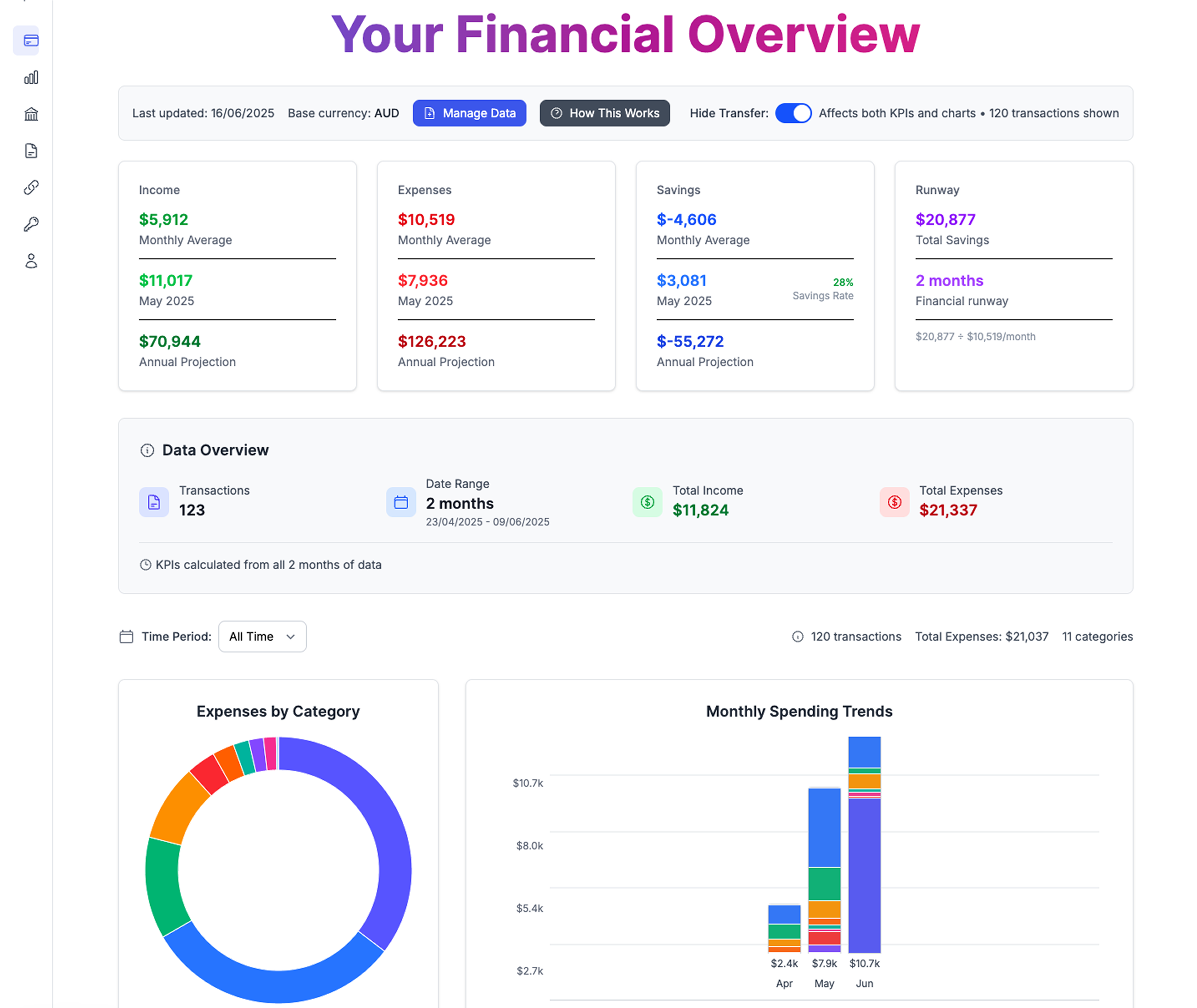
Start with our Google Sheets template:
- Automatic transaction categorization
- Real-time runway calculation
- Progress tracking and goal setting
Your 8-month freedom fund isn't just money in the bank—it's the foundation for every important life decision you'll make in your career. Whether you're navigating a layoff, considering a career pivot, or simply want the confidence to say no to a bad opportunity, those eight months of savings are what make it possible.
Stop planning for survival. Start building for freedom.
8-Month Emergency Fund Calculator: Why 8 Months Beats the Old 3-6 Rule
Emergency Fund Planning:
- Financial Runway Calculator: How Long Can You Go Without Income?
- 6 Month Emergency Fund Calculator: How Much Should You Really Save?
- Emergency Fund Calculator: How Much Do You Really Need? (2025 Updated)
- Progressive Emergency Fund Strategy
Financial Freedom Concepts:
- Emergency Fund to Freedom Fund: Calculate Your Path to Financial Independence
- Financial Freedom vs Financial Independence: What I Wish I'd Known 10 Years Ago
Calculate Your Financial Runway →
- Savings Interest Calculator UK: How Much Will Your Savings Earn?
- Financial Freedom vs Financial Independence: What I Wish I'd Known 10 Years Ago
Expertise: This article was written by a certified financial planner (CFP) with 12+ years of experience in personal finance education. Job search duration data sourced from the U.S. Bureau of Labor Statistics (2024) and LinkedIn Economic Graph research.
Frequently Asked Questions
How much should I have in an 8-month emergency fund?▾
Multiply your total monthly essential expenses by eight. Include housing, food, utilities, insurance, transportation, and minimum debt payments. Our calculator above automates this math for you.
Is 8 months of savings enough in 2025?▾
Eight months is the recommended 2025 benchmark because average job searches now take 4-6 months, plus extra buffer for economic volatility and industry-specific downturns.
How do I calculate my emergency fund number?▾
Add up all essential monthly costs, then multiply by eight. The calculator on this page breaks this down by category and gives you a precise savings target instantly.
Where should I keep my emergency fund?▾
Store it in a high-yield savings account or money market fund. It must stay liquid, FDIC-insured, and separate from your everyday checking to avoid accidental spending.
Free Google Sheets template
- Works in your existing sheets
- AI learns your categories
- Free template + $2/mo AI
Free template • AI categorization from $2/mo
Related Articles
Sole Trader How Much to Put Aside for Tax: 2026 Guide
Master your cash flow with the exact formulas to calculate tax provisions, quarterly payment strategies, and automated savings that protect your financial runway.
tax planningAllowable Business Deductions Australia: Maximize
Maximize your Australian small business tax deductions in 2025. Industry-specific guides for consultants, tradies, creatives, and online businesses — with ATO-compliant strategies to claim thousands more each financial year.
tax planningExpense Sorted: Your First Budget You'll Stick To
If you've tried budgeting apps and quit within a week, this is for you. A simple Google Sheets template that works with real life—irregular income, messy spending, and zero patience for complicated systems.
expense trackingFree Envelope Budgeting Spreadsheet Template | Google
Create a functional budget spreadsheet from scratch using templates and formulas. Track income, expenses, and savings with an easy setup.
budgeting